
How to Support Your Team Through a Reorg Without Losing Trust

How to Support Your Team Through a Reorg Without Losing Trust

A reorg changes more than structure

A reorg may look clean on a slide. New boxes. New reporting lines. New roles. New efficiencies. To the people inside it, a reorg often feels much less tidy. It can disrupt identity, belonging, influence, decision rights, and the informal relationships that helped work get done.

Deloitte’s 2026 Human Capital Trends research found that only 27% of respondents believe their organizations manage change effectively, while 85% say it is critical to build the ability for organizations and workers to adapt at the speed today’s world requires. That gap is where trust can get lost.

What people are really asking during a reorg

Employees may ask about titles, managers, timelines, and responsibilities. Underneath those questions are deeper trust questions.

  • Am I still valued here?
  • Who has my back now?
  • What work actually matters?
  • Will this make my job harder?
  • Are leaders telling us the truth?
  • Do I have any voice in what happens next?

Leaders do not need to have every answer. They do need to understand what the questions are really carrying.

Five ways to protect trust during a reorg

  • Explain the why in plain language. People do not need a 40 slide deck. They need a reason that makes sense.
  • Clarify what is changing and what is not changing. Stability matters when people feel surrounded by movement.
  • Name what is still undecided. Saying “we do not know yet” builds more trust than pretending every loose end is tied.
  • Create listening loops. Give people a way to surface friction before it becomes resistance.
  • Support managers first. They will carry the message into the emotional middle of the organization.

Trust is not protected by perfect messaging. It is protected by honest, repeated, human communication.

The biggest reorg mistake

The biggest mistake is treating the reorg announcement as the finish line. The announcement is only the beginning. The real work happens when people try to operate inside the new structure and discover what is still unclear.

This is why SHRM’s coverage of layoffs and trust is relevant even beyond layoffs. When people feel decisions are abrupt, unclear, or poorly communicated, trust fractures. Reorgs can create the same damage when leaders underestimate the emotional and operational transition.

Heather’s Field Note

Heather’s Field Note

Almost a decade ago, I recall being in between two reorgs while I was leading an eclectic team. I was a mid-level leader, and I was supposed to help them make sense of it. Personally, my position was impacted by each reorg. Yet, I was supposed to smile through it all and support everyone else. I wondered why they didn’t ask my opinion before they made the changes. The decisions seemed unclear and poorly communicated. While I understood that reorgs are a part of business, their lack of including my voice and the abrupt nature of the change left me feeling alone and like I couldn’t trust anyone. I stayed there for a year more. Then, I exited to start my own company.


The leadership takeaway

A reorg will always create some disruption. It does not have to create distrust. Leaders who stay present, honest, and clear give people a steadier place to stand while the structure changes around them.

How Heather helps

Heather R. Younger helps leaders build Unshakable Teams through reorgs, restructuring, layoffs, mergers, and uncertainty by restoring trust, clarity, connection, and focus. Her work can support organizations through keynotes, leadership team offsites, listening sessions, executive roundtables, moderated panels, culture consulting, and Unshakable Team workshops.

If your leaders are trying to steady teams through change, Heather can help you create the clarity, trust, and connection people need to keep moving. Start a conversation about bringing Heather to your organization.


 

FAQ

How do you support employees during a reorganization?
Support employees during a reorganization by explaining the purpose of the change, clarifying priorities, communicating often, listening deeply, and helping people understand how their work fits into the new structure.
Why do reorganizations damage trust?
Reorganizations can damage trust when people feel surprised, excluded, confused, or misled. Trust is protected through transparency, empathy, consistent communication, and follow-through.
What should managers do during a reorganization?
Managers should stay close to their teams, clarify what is known and what is still evolving, collect questions, reduce rumor, and advocate for the support their teams need from senior leaders.
How long does it take teams to stabilize after a reorganization?
Stabilization depends on the size of the change, the level of trust before the reorganization, and how clearly leaders communicate roles, priorities, and decisions afterward. Consistent leadership can help teams regain clarity and momentum.

Leave a Comment

Becoming Unshakeable Podcast

With Heather R. Younger

Becoming Unshakable is the podcast for leaders, creators, and changemakers who know TRUE LEADERSHIP starts from within.

Each episode explores what it takes to lead with resilience, compassion, and purpose while staying human through it all.

Through candid conversations with executives, frontline leaders, coaches, and everyday heroes, Heather uncovers the real stories behind growth, compassion, setbacks, and transformation.

From navigating change to creating emotionally safe cultures, Becoming Unshakable reveals what it really takes to create leaders—and organizations—that can’t be shaken.

Hi, I'm Heather

I've been through every type of
ORGANIZATIONAL CHANGE
you can think of.

Layoffs, reorgs, mergers, acquisitions and major technology shifts. More than 20 years leading teams through high-stakes situations where results mattered, people depended on me, and decisions couldn't wait.

Those years taught me how to lead. But they also showed me the hidden cost of always being the one who holds it all together.

During our second reorg in less than a year, I walked out of a meeting with no say in what was happening, just marching orders. When my team asked how the meeting went, I should have said, “Give me 15 minutes to process this.” But I didn't. Instead, I let them absorb every ounce of my frustration.

Then I saw their faces.

The people who looked to me for stability had just watched me unravel. What was that teaching them about their ability to handle the pressure?

That moment changed how I saw my role as a leader. Leading teams isn't only about grit or resilience. It's about how your presence builds the trust your team needs to function when things get hard.

Today, I help organizations build unshakable leaders, teams, and cultures. Because when leaders become the calm teams can count on, organizations don't just survive change, they come out strong enough to handle what’s next.

Heather Sitting
Best Gift Ever

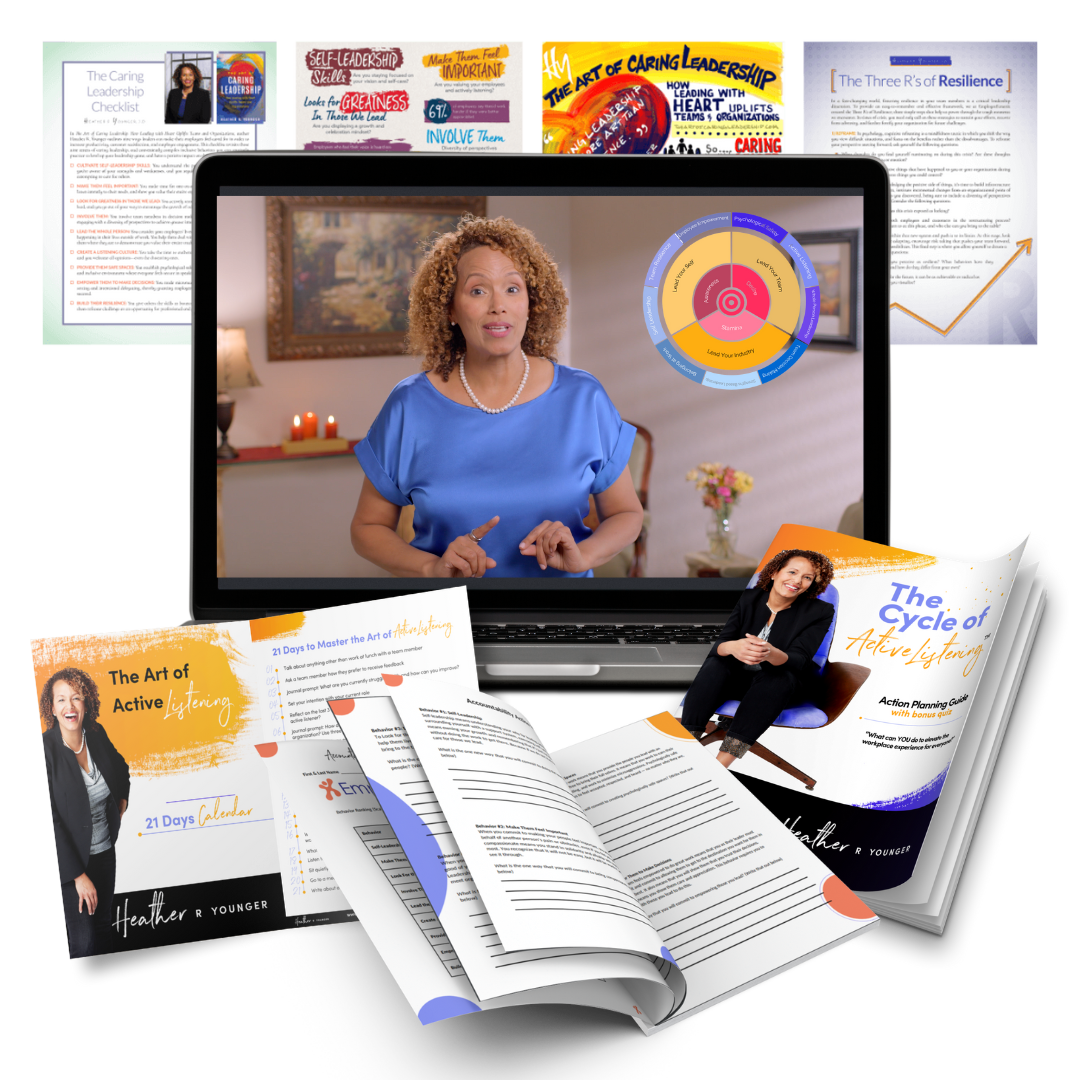
Caring Leadership Kit ...A Free Gift of Resources Designed to Help You Reach Your Full Potential as a Caring Leader

Access Free Gifts Including Caring Leadership® Videos, Active Listening Guides, Accountability Plans, and Resources

  • A checklist with the 9 key tenets of caring leadership to help you have a positive impact on those you lead.
  • The Three R's of Resilience: an easy-to-remember and effective framework and cheatsheet so you can fortify your organization for future challenges.
  • The Art of Caring Leadership downloadable and printable poster, to remind you of the central tenets of caring leadership while brightening up your office!
  • The Cycle of Active Listening Guide with 20-point quiz so you can elevate the workplace experience for everyone.
  • The Art of Active Listening 21-Day Calendar for simple ways to be a better listener.
  • Caring Leadership® Accountability Plans, videos, and more!

Contact Heather Today!
+1 (720) 295-1194

Contact
Contact

I'm really interested in...

(select all that apply)*

I can be reached at...

Contact Heather Today!
+1 (720) 295-1194

Contact
Contact

I'm really interested in...

(select all that apply)*

I can be reached at...